
What Real AI Data Governance Looks Like
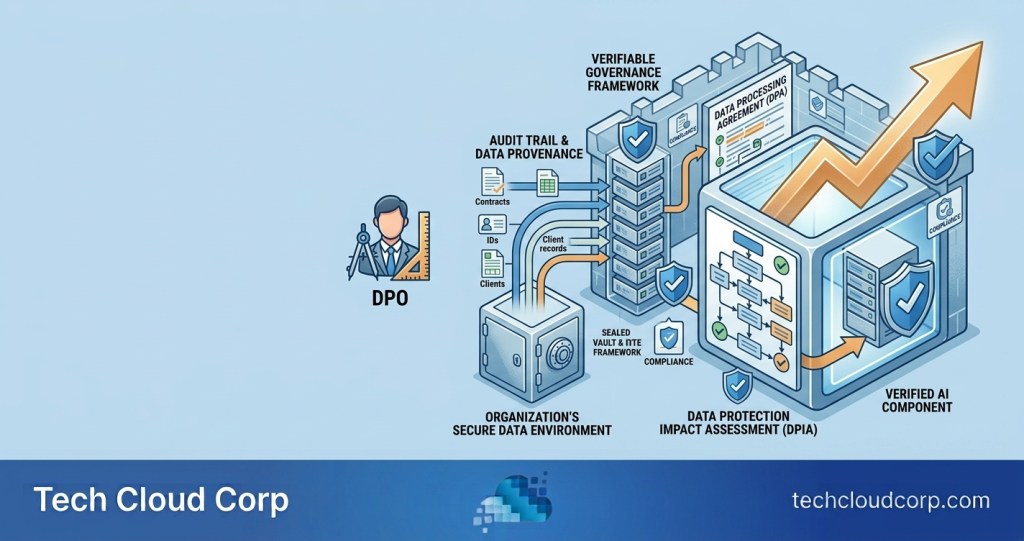
When AI companies carry out comparisons they use imprecise and unverifiable statements concerning data privacy, such as saying “your data will be safe” or “we have enterprise-grade security”. This kind of language is easy to come up with and hard to verify, no matter where your business is located.
The exact law differs from one jurisdiction to another, but what is consistent is the basic issue involved: can the vendor tell you exactly and in a verifiable way where your data is sent when it is processed by an AI system, and can that be backed up by something that is enforceable rather than merely a promise?
The DIFC Data Protection Law No. 5 of 2020 offers a clear and practical illustration of what genuine enforcement means and is included in the regulatory framework of Dubai’s International Financial Centre. While it is not the only strict standard that is available, it does act as a complete and particular example of what “real governance” actually demands in written form.
What a rigorous framework actually requires
DPL 2020 is based on the same fundamental principles as GDPR and most serious data protection systems worldwide: fairness, purpose limitation, data minimization, and accountability. It also uses a Controller/Processor/Data Subject framework. In practice, this entails:
- Organizations must maintain records of what personal data they hold, where it comes from, and who processes it
- High-risk processing activities require a Data Protection Impact Assessment before they happen, not after
- Processing agreements with any third party, including AI vendors, need specific contractual terms, not a general terms-of-service click-through
- Some organizations are required to appoint a Data Protection Officer
This problem is not unique to AI or to the DIFC; it applies to any system that deals with personal data where there are similarly strict regulations. AI just makes it easier to violate the rules without realizing it. For example, a chatbot connected to a CRM or a model that has been fine-tuned on client records is handling personal data whether or not anyone documented that it’s happening.
Where most AI deployments quietly fail this, anywhere
The reason why there is no malice is because of the default settings. The standard terms of a consumer AI tool were not drawn up with any specific jurisdiction’s requirements regarding the processing of data in mind, whether those requirements related to the DIFC or not. In most instances, when an employee copies client data into a general-purpose AI tool, the resulting interaction is not covered by a processing agreement that meets strict regulatory requirements. The company is still liable even though the actual processing took place on infrastructure which it does not control and cannot audit.
What real governance should mean, in any AI vendor relationship
Whatever framework actually applies to your business, the practical difference should show up in three places:
- A real written agreement, not merely a policy statement, clearly outlining the data handling responsibilities from the very beginning of the engagement.
- You can check where the data is stored; not just the assertion that your data is safe with us, but a clear statement as to its physical location and who has access to it.
- Compliance is set up during the planning stage and is not introduced later when problems have already occurred.
The practical takeaway
Real AI governance does not involve avoiding AI; rather, it means knowing, in specific and verifiable terms, where personal data is sent when an AI system comes into contact with it, and ensuring that this information is recorded before the system is put into use, regardless of which particular law applies to your business.
This is general information and should not be regarded as legal advice; businesses are advised to obtain advice from qualified legal professionals about their specific obligations under the relevant data protection law before finalizing any agreement with an AI vendor.
Tech Cloud Corp designs and delivers custom workflow automation and Private GPT systems for businesses across the UAE and internationally. If you are considering an automation project and want to talk through what it should actually involve before committing to anything, get in touch.